
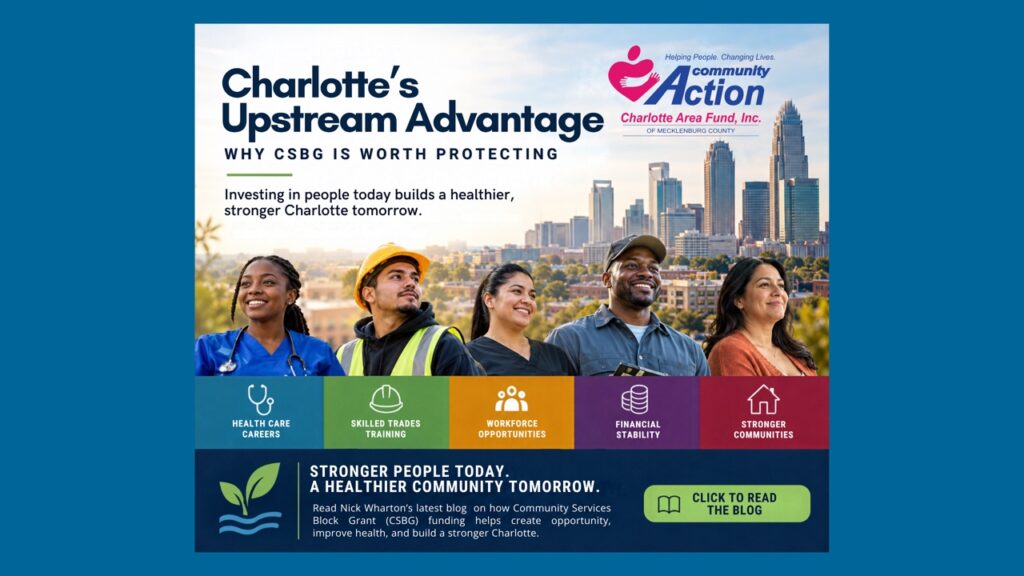
Charlotte’s Upstream Advantage: Why CSBG Is Worth Protecting
By Nicholas V. Wharton
Every week, Charlotte Area Fund trains someone to become a CNA, dental assistant, CDL driver, or skilled-trades worker through initiatives including the city’s Skilled to Build Mobility Workforce initiative, city and county Opioid Settlement Recovery funds, and ABC’s Pathway to Wellness HVAC training program. We also help residents build credit through our LISC Charlotte Financial Opportunity Center® program.
To most, that looks like a patchwork of local programs. It is actually upstream community infrastructure, stabilizing conditions that shape health before anyone gets sick, with a return most public investments can’t match.
Charlotte’s stakes are not abstract. Harvard economist Raj Chetty’s mobility research ranked Charlotte 50th among the nation’s 50 largest cities in a poor child’s odds of reaching the middle class. Oxfam America’s Best States to Work Index ranks North Carolina the worst state in the country for working people. Same problem, two measurements.
The proposed federal FY2027 budget receiving strong opposition would eliminate Community Services Block Grant funding for agencies like ours nationwide, alongside cuts to LIHEAP, weatherization and Head Start. CSBG provides base funding behind Charlotte Area Fund’s work and, across the Southeast, more than 200 Community Action Agencies serving four million people annually. An estimated $150 million in Southeast CSBG funding could be eliminated.
The case for treating this as prevention, not just welfare, is three decades old. Dr. Norman Anderson, founding director of the NIH’s Office of Behavioral and Social Sciences Research, showed that chronic poverty-related stress dysregulates the body, producing “allostatic load” that surfaces later as hypertension, diabetes, and heart disease. Roughly 80% of health outcomes trace back to conditions like housing, income, education, and job stability, not clinical care.
Charlotte Area Fund shows what mitigation looks like. During COVID, it leveraged $1.9 million in CARES Act funding as an emergency first responder, and then-Gov. Roy Cooper recommended it for a $1.1 million unrestricted IKEA grant as a trusted strategic partner. Nationally, CSBG’s $770 million leverages $9.5 billion, a 10-to-1 return; Head Start returns $6.30 per dollar invested; weatherization returns $2.51 in health savings per dollar. Skilled-trades careers like the HVAC training we provide carry starting wages of $49,000 to $99,000. Eliminating CSBG doesn’t erase economic instability; it shifts costs downstream into emergency rooms and Medicaid.
North Carolina has 34 Community Action Agencies serving families at or below 125% of the federal poverty level. The state is investing $213 million in first-year funding from the U.S. Centers for Medicare & Medicaid Services through the North Carolina Rural Health Transformation Program, covering nearly three million rural residents.
I am advancing a Root Cause proposal to bring CAAs fully into that infrastructure, aligning hospitals and CAAs to share referral data and track outcomes against Medicaid cost avoidance. Hospitals, health plans, and employers can help by screening for social and economic stressors, referring people into CAA services, supporting education and health literacy, and sharing outcomes data.
As a member of the Community Advisory Board at Atrium Health Wake Forest Baptist Comprehensive Cancer Center, I’ve seen what that partnership can look like. We are asking healthcare institutions, insurers, and related industries to treat community benefit dollars and workforce partnerships as investments, not charity.
I will make this case to Community Action Agency leaders this October at the Southeastern Community Action Conference. It is a regional argument, not one city’s.
Charlotte Area Fund’s mission is “Helping People. Changing Lives.” It works because it happens early, before a missed paycheck becomes an eviction, before a stressor becomes a diagnosis. Community Action Agencies cannot rewrite the policies that shape poverty, but they can blunt its health effects.
Congress should fund CSBG, LIHEAP, and Head Start at full strength. A region with the poorest states, the worst mobility, and the greatest need cannot afford to lose the infrastructure built to interrupt that pattern.
Nicholas V. Wharton is President and CEO of Charlotte Area Fund, Inc., in Mecklenburg County. He received the 2025 C.W. Williams Community Health Center Leadership Award, serves on the Community Advisory Board of the Atrium Health Wake Forest Baptist Comprehensive Cancer Center, and co-chaired the American Cancer Society’s 2025 Taste of Hope Gala.