
Black History Lives in Us
Black history is often taught as something behind us—a chapter completed, a struggle survived. But the truth is more demanding, and more hopeful: Black history is alive. It breathes through the people who carry its lessons forward, who refuse to let progress stall, and who show up every day to translate history into opportunity.
As we recognize Black History Month in 2026, the theme calls us not only to remember, but to embody. To understand Black history not as a static story, but as a living force that shapes how we treat one another, how we build systems, and how we decide who belongs at the center of opportunity—and who is left waiting on the margins.
At Charlotte Area Fund, we see this truth daily. Black history lives in our clients striving for stability, in parents choosing hope over despair, and in the quiet determination of individuals rebuilding their lives one step at a time. It lives in our work because it must.
One of our team members, Terry Howard, captured this reality with striking clarity:
“Black History lives in me because it’s the foundational core for Justice, Equality, and Humanity for all that resides in me. Never to retreat or abandon the battlefield of Righteousness, especially those who reside on the outskirts of Hope.”
That battlefield is not abstract. It exists in classrooms where potential goes underfunded. In job markets where access is uneven. In neighborhoods where opportunity too often depends on zip code. History teaches us how we got here—but responsibility asks what we will do now.
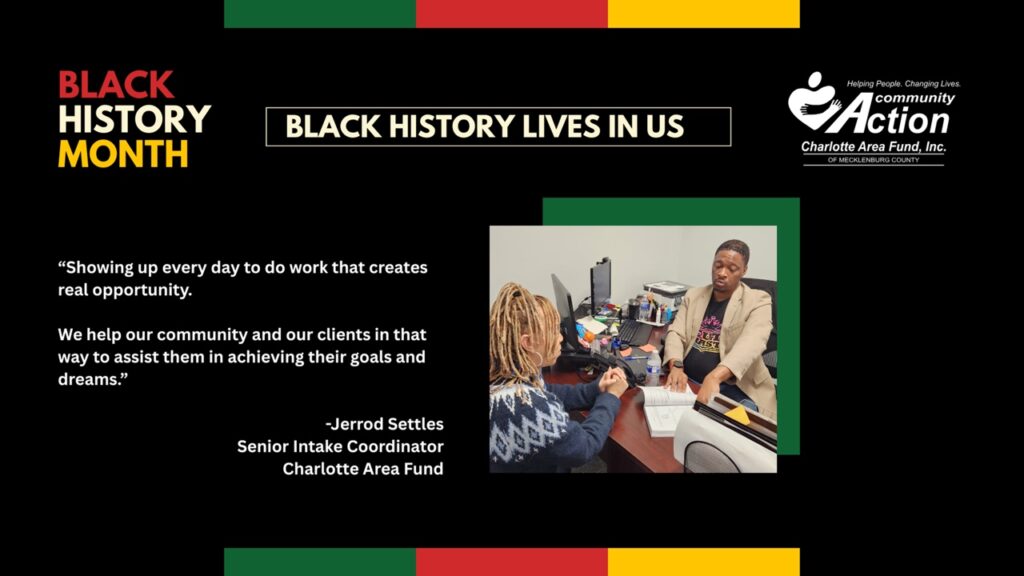
Charlotte Area Fund Senior Intake Coordinator, Jerrod Settles, reminds us that honoring Black history is not symbolic work; it is daily, practical, and urgent:
“Honoring Black History today means committing to showing up every day to do work that creates real opportunity. We help our community and our clients that way to help them achieve their goals and dreams.”
Showing up matters. Consistency matters. Systems matter. At Charlotte Area Fund, our mission is to help individuals and families move from crisis to stability and toward self-sufficiency. That mission is inseparable from Black history, because economic justice has always been central to the Black freedom struggle.
Ashley Williams-Hatcher, Charlotte Area Fund’s Program Director, speaks to the generational power of that struggle:
“Black History lives in me through the lessons passed down, the strength I carry, and the impact I strive to make.”
Those lessons—resilience, courage, accountability, and faith in collective progress—are not relics. They are tools. And in 2026, they are more necessary than ever.
If Black history lives in us, then so does the obligation to act: to invest in people, to build pathways to opportunity, and to ensure that progress is not promised but delivered. The measure of how we honor Black history will not be found in what we say this month—but in what we sustain long after it ends.
At Charlotte Area Fund, we are committed to that work. Because history doesn’t just ask to be remembered.
It asks to be continued.